Saturday, July 10, 2010

Korea University Seminars, Teaching at Daeil High School, and a Home Visit!

Day 3: Friday, 9 July 2010

Day 3: Korea University and Daeil High School!

Click on the image above to view the album

We met very early this morning to head to Korea University and were really quite a comical site. We are all dressed professionally for our university seminars and also for our guest teaching sessions this afternoon. But, we are also all hauling all of our presents, trinkets, teaching materials, etc in various travel bags for our epically long day. We also have gift bags/wrapped presents that we are carrying for the family that will be hosting us tonight.

Korea University is beautiful! Really, absolutely beautiful. The campus reminds me of Duke if the stones were a different color. Korea University is one of the “SKY” universities. These are the three dream universities for Korean students; SNU is the best. (Seoul National University). The two rival contenders after that are KU and YU; Korea University and Yonsei University (So S-K-Y…get it?). Annually 870,000 students apply to these three schools, 15,000 attend. To be accepted the most crucial element of your application is an extremely high pressure content based test that they say is most easily translated as “Korea SAT”. A university student told me today that each question you miss on the test could be the difference between getting into a really great school or a not so great school, and to miss five questions or more would be a disaster. Pressure is incredibly high.

For us, the honor of attending lectures at KU is amazing. We pulled up to the campus and our jaws dropped, it was beautiful. Then, we entered the International Studies Hall and were shown to our seminar room, and again, we were very impressed. The seminar room that we were assigned was a beautiful, formal conference room with long tables, individual mics, and executive chairs. We also were given a packet full of books, lecture notes, pens, a name tag, and a formal placard to identify us at our seat. We were then told that we would be the only people in the room over the next two weeks, so our work area is our own. Very awesome!

We had a lecture with a very dynamic, expressive professor named Mikyung Chang that was entitled “Easy Korean.” I regret to inform you that Korean is not easy. …Not at all. There are 28 characters, but it is based on sounds. …Only you combine the characters to combine sounds. Consonants can’t be alone. You can combine up to three different characters and then have to throw the phonetic sounds together. …It’s very difficult. My name basically has to be Beh-tuh Hallsah…or something like that. You can check the picture for what it actually looks like. I had to get some help. Luckily she ended the lecture with lessons on how to say some basic, essential phrases. I still have a fear of butchering them, but I am going to continue to try to get it right!

Our next lecture was on North-South Korean relations. There were a few nuggets I found especially intriguing. According to Dr. Seongwhun, North Koreans make about 50 dollars a month and 40,000 people are working to provide for 200,000 people. The total population of North Korea is unknown. The South Korean government actually provides assistance for infants and children in North Korea in terms of milk/formula and medical support (like anti-malarial medication, vaccinations, etc). Industrial workers receive basic living goods as payment; rice coupons, clothes coupon, etc. and one of the benefits of being an industrial worker is that in some of the factories you have a better chance of getting a regular warm, regular shower (at work after their shift). North Korea does not have air conditioning in the summer or heat in the winter. These were just a few things, but were some that I thought you might find especially interesting. We also discussed possibilities of unification, which the professor said he believes is feasible in time, especially because he believes North Koreans are becoming more globally aware, which makes them more aware of the disparity between the quality of life in North and South Korea and more likely to demand change.

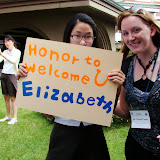
When we pulled up to the school and there was a full out banner welcoming us as honored guests at Daeil Foreign Language High School and my stomach sunk just a little bit as I had the thought, what have I gotten myself into? The nerves started kicking in. We took the elevator and were greeted by students holding signs to individually greet all 35 of us! How awesome! Then, we were told that these were the students were from the classes we would be momentarily teaching and that this was also the student who would be taking us to their homes!

Our classroom experience went very well. We were very warmly greeted by a group of energetic students and dove in! I had two MCC foam bees that went to the two students who won the map challenge we posed. That broke the ice. After that we put them in groups and my partner and I gave out our gifts. Greg had brightly colored bracelets with a note and a pin (like the one Obama wears) and I passed out the postcards my students brought in this spring. The postcards each had messages on them from my students. The Korea students were very excited! The postcards were a huge hit and I used them as a conversation piece for a while, as I shared different things about Florida and got them to speak up and participate. I asked them if anyone had special locations on their postcards and used that to cue my transition to the Kennedy Space Center. I polled the students on what they knew about NASA, shared some fun facts with them, and talked about what kinds of food astronauts eat and then I got to share my freeze-dried ice cream with them – they loved it! The kids were very excited and enthusiastic. My partner Greg then dove in and did a quick lesson on Einstein and his quest as a historian to discover whether Einstein had lived in Greg’s home in NJ or not. (He did!)

The class period was over before we knew it and soon we found ourselves heading to a gift giving ceremony and then met with a teacher from the high school and had the opportunity to pepper him with questions. When we asked about discipline, while he said it is not normally an issue, he informed us that they use corporal punishment. He also explained that to become a teacher you have to pass a government exam to be a public teacher.

After that we met up with our students and they took us home. Taeyeon was very shy at first, but opened up quickly. She showed me her room and pictures and continually asked me questions – especially about my travels. Her mom was very very sweet and her dad worked for Samsung and was very gracious as well. They lived in a Samsung apartment with a beautiful view of the Han River. Dinner was excellent - beef, romaine leaves, hot noodles, kim (seaweed) which you would wrap with rice, and other delicious dishes. I was so flattered that they had gone through so much trouble! They even had a gift for me, a beautiful Korean mirror set. The mirror is supposed to reflect hope of a beautiful life, or something along those lines, I think some of the meaning was lost in translation. I gave them a Wynton Marsalis CD, a favorite of mine and my husband – I really hope they like it!

To end the evening, we went for a walk along the Han River in a beautiful public park. There were many families strolling through the park and young couples picnicking on blankets in the grass. It was a perfect end to the day as Taeyeon, her mother, and myself walked and talked about travel, the Israeli-Palestinian conflict, marriage, the strength of Korean women, and many other things. They dropped me back at the hotel and many of us (teachers) gathered in the lobby to relax and share our experiences. We all had fantastic times! It really was an incredible experience – the Kims welcomed me so warmly. I was truly touched.

My beginning days as a Korea Society Summer Fellow

The past three days have been amazing and I can only imagine what is in store for the next thirteen! They went easy on us for the two days they considered jet-lag days, but we are now in the midst of an unrelenting schedule that has us booked from sun-up past sun-down. We have quite an adventure ahead of us! The Korea Foundation and Korea University have also rolled out the red carpet for us – we truly are receiving the royal treatment!


Day 1: Wednesday 7 July 2010


Day 1: The Korean War Memorial

Click on the image above to view the album


Tuesday morning, I woke up early, and checked out of the hotel. The Park family insisted on helping me navigate the city and make it to meet up with the teacher’s program. Before I knew it we were in the lobby and I was amongst a number of teachers who were all weary from a long trans-Pacific flight. We were mixed in with teachers from both group 1 and group 2 and headed over to the Korean War Memorial. They only had a limited number of seats on the bus, so group one and a few volunteers (myself included) took the subway. **I should note that spending a day with the Parks really gave me an edge…I had a subway pass already, I have seen many shopping areas, I have a lot of inside information about cultural practices from the conversations I’ve had with Jenny…it’s been helpful! : )

We arrived at the Korean War Memorial and were given about thirty minutes to walk around and check things out. I had enough time to walk the grounds and view many of the monuments and historical vehicles, but did not have enough time to explore the museum. As someone who is intrigued by modern history, I have put it on my to-do list and hope to return to the museum in my free time. The monuments were stunning. I am always interested in what symbolism has been incorporated into a monument. One of the statues was a large bronze statue of two brothers embracing each other. The brothers had fought on opposing sides and their faces are wrought with emotion. They are standing on top of a dome that is separated with very jagged edges to symbolize the current separation of the peninsula, but also the hope that they can become reunited at a later date.

There were many rows of military vehicles and weapons to check out including B-52 bombers, Korean fighter planes, US cargo planes, many different tanks and weapons, ships, and my favorite – the missiles. After running around in the sun trying to make every second count I was relieved to collapse in a chair in the auditorium for our first guest speaker. We were extremely fortunate to be graced with the presence of General Paik Sun Yup who was one of the generals leading the Republic of Korea’s military during the Korean War. Even as an elderly gentleman of ninety, he passionately described his version of the war. It is always extremely interesting to listen to different people’s interpretations of events, and this was no different. His lecture style was interesting and was different from the US story-based lecture style. It was such an incredible honor to hear his story!

The remainder of our day was spent getting lunch at a local department store food court. We were mesmerized by the extravagance and multitude of choices in the food court. Afterward, we were deemed free and were able to rest, explore, etc. We each crashed in our own way and prepared for our next adventure.

 
Day 2: Thursday, 8 July 2010
Day 2: The National Folk Museum


For day two, we headed to the National Folk Museum and were given time to explore the grounds and museum on our own. After having read a detailed book on Korean life and culture, I really enjoyed the life and culture section of the museum that confirmed the different facts I had read and gave me the opportunity to see pictures or artifacts from the rituals and ceremonies I had read about. I was really drawn to the beauty of the Korean craftwork.

After this, we headed to Insadong, a local shopping area, for lunch and shopping. We really enjoyed our wanderings – this shopping area has a little more artsy feel and many of the goods were more customized and tailored. We grabbed a cab with enough time to clean up and prepare for our orientation dinner. At the dinner, we were briefed on the mission of the Korea Foundation, the sponsor of our program and served a beautiful dinner. Again, we were flattered and felt very warmly welcomed!
And then we received our schedule for day three…and braced ourselves.

Thursday, July 8, 2010

Exploring Seoul with the Park Family!

My day in Seoul with the Park family!

Click on the image above to view all the photos in the album

First of all, I don’t think I will ever be able to express my gratitude to the Parks for their kindness, generosity, openness, warmth, and hospitality! They made me feel incredibly welcome in the city of Seoul and were wonderful hosts to me! After I said farewell to my husband in the Guam airport, I had to clear Guam customs, and re-check in for my alternative itinerary. I then boarded a plane for Nagoya, Japan and braved a Japanese airport for a while (which was actually very clean, well labeled, and very pretty). From there I flew onto Seoul and was soon greeted by one of my MCC students (and one of my Model UNers), Jenny Park, Mrs. Park, and Jenny’s brother and sister.

In seconds I was transformed from being an English-speaking foreigner to being embraced as an honored guest by the Parks. They swept me up and made me feel incredibly welcome. Before I knew it, I had dropped my bags at my hotel and was at a beautiful dinner. The style of meal was called “kalbi” and consisted of a variety of delicious side dishes that you eat with grilled meat. Only…the meat is grilled at your table on a little mini grill in the center of your table. …So, think fondue, but with a grill instead. The waitress continually lays more beef or pork out and then cuts it into strips. You then eat the piece of beef with other side dishes, like sautéed peppers, raw onion strips, or greens in a sesame pepper sauce. You can also take the meat and wrap it in a piece of romaine. It’s delicious! (And!...Mrs. Hals managed to eat it all with chopsticks! My chopsticking ability was even praised by the Park family, although I have suspicions that they were just being kind). Mr. Park joined us for dinner as well and I was able to debate the strengths and weaknesses of the US law system with him – very intriguing!

After dinner we enjoyed some very delicious, light, refreshing desserts at a coffee shop. Jenny and I split a big bowl of shaved ice topped with raspberry syrup and fresh fruit. It was yummy and is a new favorite dessert of mine.

The next morning, Jenny, her brother, and her mom, met me at the hotel and took me sightseeing. They ran me ragged, but we had a fantastic day! I can’t possibly describe every second of it, but I’d like to share a few highlights with you:

One of our first stops of the day was Bongeunsa, a Buddhist temple in the heart of the city. It was my first Buddhist temple and was absolutely beautiful. Jenny’s mom told me lots of little details and patiently answered the multitude of questions I had as Jenny translated for the two of us. The interior of the temple was beautiful (I don’t have a picture, because it would have been rude), but the ceiling was lined with prayers, hanging from flowers, that people had paid money to have placed there. The right wall was lined with little golden Buddha statues that Jenny’s mother explained people had purchased and on the left wall were two big fancy ships that had boards with smaller papers added to them. I was told these were spots purchased by families to ensure their deceased family member had a seat on the boat that provided safe passage to the Buddhist version of heaven. There were many opportunities throughout the grounds to purchase prayers that would hang in various ways throughout the complex (check out the pictures). We walked the grounds and witnessed a monk’s funeral prayer going on in one of the temples, saw a very large Buddha statue, stopped by the pagoda that housed the large bell and drum that are sounded on festival days, and enjoyed the view of Seoul.

Shopping was quite an experience. As we traversed through the city, they showed me several different amazing shopping areas. First, Jenny shared Coex with me, which is her favorite place to meet her friends. Coex was a very cute mall with lots of fun stores (now I know where she gets her adorable pencil cases!) We visited several other shopping centers, some of which were malls, others were markets. The market was amazing. I’ve been to many foreign markets, but never to one like this. The quantity of goods available was absolutely astounding to me. And everything is clumped together by topic. So we walked through probably 100 or 200 stations selling jewelry. (I’m going back!) We walked by row after row of souvenirs, row after row of shoes, food, etc. It was really neat! We also went down to a grocery store (which was the basement level of a mall) and her mom showed me many different fish, fruits, vegetables, that were unique to Korea (or at least not normally found in the US). It was really interesting and gave me a great feel for the shopping opportunities in Seoul.

Jenny also showed me the Korean spin on a photo booth (you know, like the one in Melbourne Mall that you sit in, make funny face, get a little strip of pictures…), only this booth was very high-tech in my opinion. We had an interactive touch screen and a green screen behind us. We picked out our backgrounds. We then went to a different booth and used a touch screen to decorate our photos, add cute little digital stickers, crop, label, you name it. Very fun! (You can see our final product in the album above…let’s just say I laughed, a lot).

The last thing I did with Jenny and her mom was go to the top of the Seoul Tower. To get to the base of the tower you have to find a way to get up a very long, very steep hill. Because of the intensity of the traffic, Korean residents are expected to walk or take a public bus. If you are a foreigner, you can take a taxi or a cable car. So, the Parks were very excited to use me as an excuse and to be able to take a taxi to the top (I was more than happy to oblige). :) At the top of the hill, we waited for the sun to go down with the idea that it would be prettiest to see the entire city at night. So we enjoyed the view from the lookout, watched teenage couples attach locks to the railings and throw away the key (thus locking in their love), snacked on frozen yogurts and coffees, and had great conversations. The view from the top of the tower was beautiful and was a perfect end to a great day!

The Parks gave me a wonderful inside look into the city of Seoul! It really is an awesome city and I am very excited to have two more weeks here! I still cannot thank them enough for their amazing hospitality!

PS – I have resigned myself to accepting that I will probably continually be about 2 days behind on this blog. Internet has not been reliable (the past two hotel rooms I have had do not have working internet in the room…what are the odds?) I’m trying! And will keep posting! But just realize it probably happened two days ago. I met up with the teachers program on July 7th and have had two easy days as everyone else is jetlagging, but tomorrow is the big day! We are leaving for Korea University at 7:15 am and have a FULL day planned, several seminars with KU professors, lunch, a meeting at a local foreign language high school, my guest teaching session with the students, a meeting with the principal, and an afternoon and dinner with a student’s family! A full, full, full day! Wish me luck! : )

Palau -- Part III: Stingless Jellyfish?!?!

Jellyfish Lake

Click on the link above to view the album

Stingless Jellyfish? Yeah right! They exist, they are awesome, and you can swim with them!

Visiting Jellyfish Lake was one of the coolest things my husband and I have ever done. When Daniel was in Palau ten years ago El Nino had damaged the jellyfish population enough that he didn’t get to visit the lake.

Palau has many marine lakes. Five of them contain jellyfish whose stings are so mild they do not harm you. So yes, they are considered stingless jellyfish! Not only did we get to visit the lake that the 13 million-ish jellyfish live in…we swam in it!

Now, to protect the jellyfish populations and preserve Palau’s natural habitats, the government only allows people to swim in one of the five lakes. So it is definitely a tourist-frequented destination (and you have to buy a permit to snorkel there). But, since we were used to diving at 7 am, getting to Jellyfish Lake at 7:30 was no big deal – and we beat all the other tourists and had the entire lake to ourselves.

We had to hike up and down a hill of craggy, sharp, slippery limestone rocks while carrying our snorkel gear and waterproof cameras. We all geared up and slipped into the lake. The jellyfish are drawn to the sun, they follow it out of survival. In the shade/shadows is the edge of the lake, so my following the sun, they stay in the center. Why does that matter? Because along the edge of the lake there are white anemones that eat the jellyfish. Really cool, right?

So we started swimming, because we were in the shade there weren’t any jellies and I was wondering if we were going to be disappointed, but sure enough, as we swam into the center of the lake more and more jellyfish appeared.

Swimming with them was awesome…for divers jellyfish are usually our worst enemy – they inflict so much pain! Many divers wear skins specifically to protect themselves from the potential stings. And most divers have been stung many times (Daniel and I certainly have). Instead of fearing them, we got to marvel at their propulsion system as they puttered around the lake. These jellyfish are a beautiful golden color too, so they are really beautiful to look at. Now, at first you catch yourself delicately avoiding the jellyfish, afraid to let them touch you, but the further into the center of the lake, the more inevitable it becomes for you to come in contact with them. You could pet them and hold them in the palm of your hand (well, kind of, because they continue pulsating away).

It was really awesome. Just before we headed back Daniel and I discovered you could dive down in the shadows and rise up through the clouds of jellyfish – it was incredibly fun to do. We each took turns diving down with our fins and floating up through the pretty golden orbs that felt like jello.

The rest of the day was also a lot of fun. We careened in the skiff through the famously beautiful Rock Islands and then dove the Chandelier Caves. We dawned our scuba gear one last time and swam into a cave. But! This cave has air pockets! So we were able to swim into the cave and then resurface in caverns full of stalactites and beautiful rock formations. It was a fantastic last dive.

The next morning we disembarked from the boat and spent a portion of our day doing a river boat cruise and speaking with a local guide about the indigenous plants and animals on the island. Unlike Yap, Palau has saltwater crocodiles and some of the islands have monkeys. They have a few different non-poisonous snakes. It was really neat to learn about the different island creatures that exist between Yap and Palau. The islands are only a few hundred miles apart, but still have some stark differences in terms of animals and plants. Many of the plants in Palau were introduced by the Japanese during the early 1900’s occupation.

Wednesday, July 7, 2010

Palau - Part II: Visiting the WW II sites on the island of Peleliu

Peleliu

Click on the image above to view the album (I recommend you read the entry, then view the photos)

While most days I spent 4-5 hours under the water, the day our ship reached the South Dock inlet along the island of Peleliu, I took advantage of the opportunity to enjoy a land excursion to the historic WW II sites around the island.

Peleliu was a battle that incurred extremely high casualties during the war. To make matters worse, it’s relevance to the overall war effort in the Pacific has been highly debated, and thus, it is a fairly controversial battle. It is also a battle that has recently increased in popularity and awareness because of “The Pacific” series HBO debuted this spring. There is actually an entire episode on the marine’s contributions at Peleliu, so if you watched the series, you may find this especially interesting.

I’m going to summarize what I learned, but you may also enjoy looking through the pictures and reading through the captions. We had a wonderful guide named Tangie Hesus, who is truly the local historian. He has created and maintains an interesting museum with many artifacts and accounts from the battle. He was extremely knowledgeable and did his best to answer our questions and show us around.

The marines landed on Orange Beach, attempted to take the Japanese airfield and the Japanese administration building, and then worked their way up “Bloody Nose Ridge.” We visited Orange Beach, the monument where many soldiers were buried until 1957 (they were moved to Arlington), and the remaining walls of a chapel that had been built on site. Tangie told us of the struggles to gain position on Orange Beach and told us many stories of marines returning to Orange Beach and the nearby jungle and sharing stories of how their best friends perished. The beach was 118* the day of the battle (Palau is only 7 degrees from the equator). It was sobering to stand on a beach, now calm and peaceful, that had seen so much carnage and death. The monument to the fallen marines had plants arranged to actually spell “USA.” The island of Peleliu itself lost nearly all of its vegetation during the battle – it’s hard to imagine when you’re standing there because the island really feels like a jungle. After the battle, the US tried to plant a tree that grew extremely fast to create some cover for the locals. But they planted a pine that was toxic to the indigenous plants, so now they are centering efforts on removing the pesky pine. Much of the island’s vegetation has grown back, but when you look at pictures that were taken where you were standing and see no vegetation at all, it is astounding.

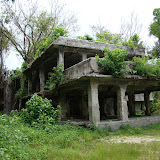
From there we drove through the airfield and onto the Japanese administration building. This building had definitely seen war. The concrete was riddled with mortar divets and bullet holes, there were gaping holes in the walls and ceiling, and rebar was jaggedly jutting out throughout the remains of the building. We got to explore a nearby Japanese bomb shelter – which I found especially eerie, because the men inside were probably forced out with a flame thrower. On some of the pillars there were tributes to the Japanese soldiers who had lost their lives with wreaths bearing a thousand paper cranes.

After stopping to see several different vehicles that had been damaged and abandoned (including a Japanese tank and a US Amtrak), we headed up the steps to Bloody Nose Ridge. Over 11,000 Japanese were entrenched in the ridge, hiding in 600 caves, as 800 snipers were perched, hidden, and ready. Our guide took us back to see a 200 mm rifle that had never been fired (it was about 90% assembled when the US arrived). We also got to go back to some of the caves where the Japanese had hidden, poised to attack.

Tangie Hesus has also created a museum full of artifacts, correspondence, and photographs documenting the perspective and experiences of both the Japanese and the American troops. We spent a little while walking through the museum and then headed up the hill on Bloody Nose Ridge and paid our respects to the Marine Monument and the Japanese Shrine.

Later on that afternoon we did a dive at Orange Beach and we saw rifle barrels, cargo boxes, fuel cells, remnants of ships…and all sorts of different war related carnage. It was all hidden with coral, but was really cool to see. I found my mind imagining how everything got there and also felt like a scuba-historian as I tried to discern whether I was seeing just coral, or historical artifacts.

It was really awesome to actually visit a WW II battle site and I was personally surprised when I realized I have never visited one before. Much of Europe was involved in the war, but nearly all of those sites have been repaired and rebuilt. There is only a small village in Peleliu, so much of the wreckage from the war remains intact. My grandfather was also on an aircraft carrier ship called the USS Cowpens, which fought in Palau, so it was really amazing to envision his ship at the ready in the waters our boat was traversing.

Palau – Part I: Diving in the Beautiful Blue Waters


The view from Ulong beach, where part of the Palau Survivor series occurred


Beautiful fish and coral at the world famous dive site, Blue Corner


Coral as far as the eye can see, again at Blue Corner


Thousands and thousands of colorful fish, swimming in our own aquarium


A beautiful sunset on the water

I apologize if I confuse anyone. I am safely in Korea now and have met up with The Korea Society teacher’s program and now hope to have a steady internet connection. I have two goals. First, to share a few highlights from my experiences in Palau, and second, to keep you posted on the many things I have the honor of learning about the history, culture, and people of Korea as a summer fellow.

Ten years ago for his sixteenth birthday, my husband’s dad took him on a dive trip to Palau. My husband loved it so much he hasn’t stopped talking about it ever since. And so, this year as we planned our summer vacation, and decided we really wanted to spend a few weeks scuba diving, Palau made it to the top of our list. Historically Palau has changed hands many times – the UK, Germany, Japan, and the United States all occupied Palau at different points in time before it became a truly independent country in 1994. Even still, there are many foreign influences – as my husband and I walked around Koror we passed a school that the US had helped construct and two other public buildings/elements of infrastructure that were sponsored by Taiwan and Japan.

From June 27 to July 5 we lived on what’s called a “live aboard” dive boat. …You literally live aboard the boat. It’s basically a large yacht that has several levels that include cabins to sleep in, a dive deck where we keep our gear and get ready for dives, a galley and dining area, and a sun deck. The daily schedule usually involves waking up around 6 am and grabbing a light breakfast; diving at 7 am; eating second breakfast (yes, we’re hobbits) that is a hot breakfast; diving again; eating lunch; diving again; afternoon tea (and something yummy and sweet to snack on); diving again; eating dinner and dessert; diving again…this time it’s a night dive; and then crashing from sheer exhaustion. You’ve earned it. There’s a reason the Aggressor advertises an “Eat-Sleep-Dive” life.

The diving in Palau has been phenomenal! The coral walls are absolutely amazing as they vertically span 90-150+ feet and stretch as far as the eye can see! There aren’t just a few reef fish, but hundreds of brightly colored fish bustling around the coral and thousands of fish swooping in schools around the reef’s edge and out in the deep blue. There’s entire underwater rolling hills and meadows of beautiful, bright, colorful corals! So…to sum it up, in Palau the coral and fishies are infinitely healthier, more diverse, more colorful, and there’s …just MORE of everything! We've gotten to do tunnel dives, cave dives, wreck dives, coral gardens, and drift dives along the coral wall - lots of fun!

Tuesday, July 6, 2010

Safely in Korea and loving Seoul!


Visiting the beautiful Buddhist Temple, Bongeunsa, in the center of Seoul

Much much more will be posted very soon. But for now, I wanted to share that I am safely in Korea and am having a wonderful time with my dear student, Jenny Park, and her amazing family!

Lots more soon! Promise!