Tuesday, July 26, 2011

July 19 and 20, 2011 - Suzhou

Suzhou was a very neat place!  The old section of town was very pretty - one of our favorite afternoons, but in this case, pictures really do speak louder than words - enjoy!


Click on the images below to view the albums:

July 19, 2011 - Suzhou

and a day with Suzhou High School and Suzhou International High School - one of the finest and most gracious in China!  It was a neat day!

July 20, 2011 - Exploring Education in Suzhou

July 18, 2011 - Shanghai: Musings about a truly commercial city

I was secretly hoping that the American Chamber of Commerce in Shanghai would be a breath of home…and it was…with a Starbucks on the corner and a restroom with free toilet paper AND non-squattie toilets it was a perfect oasis.  

Our speaker, Oliver, was fantastic…here are some of the highlights I gleaned out as I am still trying to wrap my brain around China and put it all into perspective:
-18 cities in China have populations over 8 million
-China has the third largest economy in the world with a GDP of 4.9 trillion USD
-Foreign investments employ 8.2% of Chinese
-Shanghai is a city of 24+ million people with a per capita of 11, 563
-Shanghai’s economy grew 9% in 2010
-Shanhai’s import/export volume exceeded $684.7 billion US in 2010.
-there is a tremendous disparity between the rich and poor.  Yesterday we saw 2 bed, 1 bath apartments in the central Shanghai area are selling for 10,000,000 RMB (~1.5 million USD)while 60% of the population earns less than 3,000 RMB per month (~500 USD)…
Real estate has also sky-rocketed at a rate we can’t really fathom …in the past 10 years real estate in Shanghai has increased by 400-500%. 
-HSBC actually stands for Hong Kong Shanghai Bank Corporation
-The US, Kong Kong, and South Korea are the top investors in Shanghai, the US has about5,500 projects currently and the trade between the US and Shanghai exceeded $53 billion in 2008
-And then there is the reality check – China has become a market economy…no doubt.  However…can they sustain it?  Will there be a sustain snap in government policy that reverses much of what is going on?  Will there be a social or environmental crisis that causes such economic growth to grind to a screeching halt?  Some of the most pressing issues are: 
                -social instability
                -corruption
                -rural/urban wealth gap
-migrant worker issues – these are people who head to the cities to find grueling factory work…that is significantly more lucrative than the rural farming situation they are in.  It is usually temporary.  Int the countryside they may earn about $100 USD per year…if they move to the coast and find work in a factorythey can find a job where accommodations and food are provided and earn 200-300 USD per month working 14 hour days 7 days a week.  It is temporary…but is a true chance to break their cycle of absolute poverty. 
                -social welfare
                -collapse of state-owned sector
                -“lost generation” of laid off workers
                -privatization, shedding of responsibilities
                -environmental degradation
                -pollution and resource scarcity
                -a rapidly rising middle class
Some of these are very real threat and the combination of some of these issues could be a huge blow to economic growth, so it will be interesting to see if the rapid growth pace can be maintained. 
-The AmCham also emphasized that China has a goal of becoming more well known for producting quality products and replacing its current image on chintzy stuff.  China also wants to head into the more lucrative area of production as well – into more high tech industries and even better, into research and development.  

-Some companies have been leaving Chinese factories, because they are too expensive and then heading to SE or S Asia…but then the quality is poorer and they often return to China
-The provincial EPA does not actually report to the National EPA…so there are many issues that are overlooked or not addressed appropriately.
-Because of the pressure to produce at a low cost (and keep business in China) and the lack of agencies to ensure quality control…there are still issues with quality and purity of products.
-the people responsible for the poisoned baby formula were actually executed. 
-and the American Chamber of Commerce outright admitted “ultimately everything is manufactured in China” 

After our enlightening visit with the AmCham we visited Branson factory, which is a high tech factory that is really an example fo where China is hoping to head.  Most of the employees had technical skills or were university educated engineers.

We also visited an art district that had some intriguing pieces including one with two girls in dolled-up peasant like clothing that was meant to symbolize cute communist ideology following girls, who were standing with Shanghai in the background…with one of their hands pushing/suppressing/constraining the global financial building and other sky-scrapers of the city.  The art district was fun…although despite the picture I describe it was far more commercially geared than the politically driven district of 798 in Beijing. 

Overall it was an intriguing day!

Not labeled yet...but feel free to enjoy the album below when you click on the link:

July 18, 2011 - Shanghai - AmCham, Branson, and the Art District

Saturday, July 23, 2011

July 17, 2011 - Shanghai: A City of Commerce


We had another early wakeup call, packed our bags, and were headed to Shanghai!  This airport check-in went much more smoothly (I didn’t have to body check anyone to save our spot in line) and we were in Shanghai in a matter of hours.  Driving in we were again hit by the immensity of the city as massive high rise apartments shot up in all directions as far as the eye could see.  We enjoyed what was for me a very restorative lunch…I honestly felt SO much better after I ate.  I really feel best when I eat a sizeable portion of protein in my meal and while in Beijing I was eating less than normal, in Guangzhou I basically was just so hungry I was nauseous for days and days (I’m really not a seafood eater…so I was pretty miserable).  We were given time to settle in when we arrived and I excitedly hand-washed a very large amount of clothes, convinced they were definitely dry faster than chronically damp Guangzhou.  And then we headed out to do a walking tour of the Bund (which is hindi for embankment…so no, not German.)  The Bund was the section of Shanghai that had various foreign concessions along the coast.  A concession was an area occupied by the British or French who then had autonomy over that region.  So the British concession applied British laws not Chinese laws to their territory.  Because of this, there is very European architecture along this area and very beautiful posh buildings.  The French Concessions area was actually a hotbed for the early communist party meetings, as French not Chinese laws applied.  The concessions were torn from the French and British hands when the Japanese invaded in WW II, was then government property under the communist era after 1949, and was quickly leased by the government to various international companies after China opened up in the 1980s and 1990s.  One example is the AIA – the American International Assurance was one that bought a lease asap when Shanghai opened up and restored the reliefs that were on the outside of the historic building. 

And then we stepped up to the water’s edge and were able to enjoy the beautiful  view of the iconic high rises of Shanghai….  I am not a big high rise architecture person…usually the modern stuff is quite garish in my mind…but I really really liked the pink TV tower and the accompanying buildings of Shanghai…in fact I found them captivating. 

We were given some time to wander and I made my way down the Nanjing shopping street to a pedestrian shopping area.  Shopping is alive and well in Shanghai too.  We enjoyed a dinner and headed in for the night – my favorite hotel yet!

July 17, 2011 - Shanghai - along the Bund


Wednesday, July 20, 2011

In and Around Guangzhou - July 12-16, 2011


A tropical port city the British once called Canton, Guangzhou is still a bustling, now densely populated city that continues to thrive and boom.  Guangzhou was the only city open to outside traders and held the Thirteen Hongs, which were factories run by a myriad of international countries and some local wealthy families.  Guangzhou was the funnel city through which goods desired by the Europeans flowed out and silver flowed in during the Ming and Qing dynasties. 

China was doing very well with all of this until the British became more aggressive and brouhgt in a very potent and addictive form of Opium from Indian/Pakistan/Afghanistan region of the world.  A sharply increasing and debilitating rise in Opium addictions posed two significant challenges to the Chinese government.  First, the number of addicted members of society was crippling and affected all walks of life - from civil service employees down to the family unit.  Second, the flow of silver into China was reversed back into Europeans hands and began rapidly flowing out of China and to the British. 

When the Chinese tried to crack down on Opium trade (which they had fruitlessly outlawed), Lin Zexe, a Confucian civil servent was called in to run the show.  The Opium was confiscated and within a few weeks two million tons were destroyed from June 3 - 25, 1839.  Many history books claim the opium was burned, but it was actually destroyed by being dumped into ponds full of water and lye. 

This was the final catalyst for the Opium Wars and conflicts between the British and Chinese ensued - ultimately the British forced their way further and further into the Chinese trade system and forced the opening of multiple ports in China.  These events really begin what is known as the "Century of Humiliation" for the Chinese. 

Some highlights from the past few days:

Day 1 - We did a walking tour of Shamian, the island where we were staying - which is a lush, gorgeous island full of beautiful parks.  We capped our evening off with an evening dinner cruise along the Pearl River.  Shamian is the current location of the US Consulate office - so it is the main place families adopting Chinese babies (mainly girls) stay while they file their paperwork and create their new family.  Our hotel, the Victory Hotel is one that frequently housed those families - even more famous is the White Swan hotel which was within walking distance of us.

Day 2 - We visited the Opium War Museum (see info above) which was amazing...but no pictures were allowed and they didn't sell any books!  I copied down a lot of the important facts though, and hope to add those into my lessons!  We also visited the Naval Sea Battle Museum...which was a little more slanted and skewed and had a horribly disturbing exhibit on anti-drugs...which included jars of premature or deformed babies.  After lunch we visited Nansha Park which is a think tank, engineering, research and development park that has at least twelve technical companies currently based there - Professor Ren's friend runs the place and invited us to visit and have Ren hold his lecture there.  It was neat to learn that such a place exists and recruits the most innovative minds to come and work int he area. 


Click on the iamge below to view an album

June 12-13, 2011 - Guangzhou


Day 3 – Free Day! 
At the midpoint in the trip we were given a free day to reflect, work on lesson plans and recover.  It was amazing!  I slept far later than I remotely intended, indulged in Starbucks coffee greatness, caught up on photos and reflective thoughts, walked around Shamian island catching “slices of life” pictures – and loved every second of it, and then headed into Guangzhou with some other colleagues to find a western-style meal.  Spaghetti bolognaise…you were mine. 
***Side note – while in Guangzhou there were many moments in which I was so hungry I felt nauseous.  It is a sea food city and I am not a sea food girl.  I have since recovered…but it was a really really really challenging few days for me.   

Day 4 - The Soul Breaker. 
This day started out really cool - we took a high speed train to Shenzen, a rapidly developing city that is sandwiched between Guangzhou and Hong Kong (it’s still part of the PRC, but is a 15 minute high speed train from Hong Kong).  We met with a US citizen who is working as an urban planner for the city and were all absolutely baffled by the rate at which Guangzhou has grown.  …30 years ago Shenzhen had a population of 30,000…now it has a population of around 15 million.  HOLY COW!  It has the countries largest migrant population – but it was within the 1st Special Economic Zone that was  created after the reforms in 1978 and has since become an incredible market economy international city.  We learned many interesting points about how the government technically owns all the land but different companies lease it for 40, 50, and 70 years at a time and pay allotments to the government for this….it all is working beautifully…but you have to ask yourself – can this rate of change be sustained?  and…what if the government changes its mind? 
After that we visited the local library, other sites within the city and other architectural marvels, and then visited a delicious hot pot place.  Then we were off to visit a neighborhood that had been built and was selling for…WAY too much money…   Basically it was 1.5 million USD to buy an apartment unit and 3,000 USD to rent the equivalent of a 1,000 sq ft apartment.  Yikes. 
I should mention it was raining through a lot of this…and proceeded to rain much harder as we neared the edge of Shenzhen and prepared to visit one of the local theme parks – the Folk Culture one.  …It was pouring when we stepped off the bus…and we were given almost two hours to explore.  I don’t want to complain much further…but let’s just say I was soaking wet and cold and miserable for the remainder of our seventeen hour day. 
We saw a show before leaving the park that was a variety show of the different “traditional” dances from the regions of China…at the very least I can say it was very entertaining.  But then we still had dinner, a bus ride to the train station, waiting for tickets and our train, a train ride, and a bus ride to our hotel…all while wet, cold or far too hot at times, and being exhausted and miserable.  We had left our hotel rooms at 6:20 am…and returned back at 11:30 pm, soaked and exhausted.  Morale was low.  ..or at least it was for me…

Day 5:  Urban Village of Liede
We visited a primary school which made us feel incredibly welcome and boasted its incredible attempts at project based learning.  I say attempts, because when you read between the lines it is difficult to differentiate whether the learning was rote with some fun twists, or was actually constructive/project based.  …Regardless, it seemed to be a far more progressive school than most and we had the honor of visiting the school’s newly created cultural museum that documented the history of the village of Liede. 
We learned a great deal about urban villages – which exists in cities where the rural areas are quickly surrounded by the city and high rises.  In this case, Liede negotiated, made a deal, sold off parts of their land, and on the remaining parts built a beautiful, multi-high rise apartment complex.  Many of the initial villagers own not only their own apartment, but multiple others, and make their living renting out the space…the tricky thing is that they cannot actually sell the property…but they can make money off of rent. 
We had the honor and privilege of visiting the Urban Village of Liede with a graduate student in anthropology who had worked explicitly with this neighborhood and was more than happy to fill us in.  It was very intriguing to stand within the urban village space and feel the city sprouting all around me…and yet feel like I was in an escape as I gazed into the beautiful reflection ponds and ancestral shrines they had. 
We finished our day with time in the center of Guangzhou as we admired all of the new, glitzy architecture and enjoyed a dinner at a famous seafood restaurant in town  ( I was thoroughly depressed by the types of fish they offered from the tanks down stairs though…) 

Click on this image to view the album

June 14-16, 2011 - Gunangzhou, Shenzen, and Liede

Since Guangzhou we had headed to Shanghai for one and a half days and are now in Suzhou.  More info soon! 

Thursday, July 14, 2011

The Great Wall of China!

Well, according to Mao, I am now a man!  I hiked up to the Great Wall of China at Mutianyu today and then walked along the wall among several watchtowers, all while breathlessly in awe of the incredible view and the epic, winding man-made fortification that stretched endlessly in front of me!  There are multiple places in which you can visit the wall – we visited the Mutianyu section.  It was quite a climb up, although the scenery was very peaceful and beautiful…but you were automatically dripping.  We were all absolutely soaked through by the time we reached the top.  It was a hazy day – but the sleepy mountains around the Great Wall were still beautiful.  The portion of the wall had been fortified and built up during the Ming Dynasty (14th-17th century)...the wall itself was developed from the 1450s-1560s to strengthen the empiere's defense against the Mongols.  The Great Wall was originally built under Shi Huangdi's guidance during the Qin dynasty back in the 200 BCE's...but the original, not altered sections of Qin wall are very remote and hard to reach. The wall wasn't perfect, and it didn't fully protect China...but it does showcase China's ability to utilize resources. 


The Great Wall was amazing, and we had a really wonderful time...but I will let the photographs speak for me...enjoy! 


Click on the image below to view the album! 

Great Wall Pics

Wednesday, July 13, 2011

Temples and Palaces and an Imperial Dinner in Beijing!

Beijing has been an interesting experience…it is not an ancient hub of China, but more a key location for modern and contemporary history.  The city is quite full of people, as every city in a country of 1.4 billion people would be, but was not as  populated as I anticipated.  The inner circle is about 6 million people, and if you include the outer lying areas of Beijing it’s about 12 million or so.  As the capital it is a destination many families from the country side are choosing to visit, so some of the major historical sites have a pilgrimage feel to them and many of the people we have encountered at the monuments are actually not from Beijing.  The smog and pollution has been staggering and I have been in true disbelief of how truly truly thick and ever present the smog can be – at moments I have had visions of the movie Mist…it really can be nearly that bad.  The smog swallows up whole s buildings, trees, even skylines here.  The people have been very kind and many have been friendly…we have been photographed many times, (although not quite as ridiculously as when I went to the pyramids), and the people have been outright helpful.  Today I visited the great wall and was very grateful when a woman picked up the lid to my water bottle (which had fallen off and rolled down fifty or so stairs) and handed it to me as she walked by.  The children are very eager to practice their English and have been very sweet – and the affection parents have for their children has been wonderfully evident in their interactions. 

The WHA conference was ultimately a success for me in that I walked out with new ideas, new contacts, and for the first time since the end of my harrowing school year, some excitement about my courses and students next year as I have started brainstorming new activities for my AP European history students and am steadily evolving the curriculum unit I will be writing for the China Institute and using in my world cultural geography course.         
                                         
 We have spent several days attending the WHA conference in the morning and then spending our afternoons visiting various historical or cultural sites.  One of the days we visited the Temple of Heaven – which was the Imperial temple the emperor would visit to ensure that the Mandate of Heaven was not lost and that he honored the power bestowed upon him accordingly – the most important ceremony was when he would go and appeal for a good harvest – everything had to be done in a precise way.  And he was carried in to the complex up to the certain point.  It was really a beautiful complex and we really enjoyed our time there. 


July 9, 2011 - The Temple of Heaven

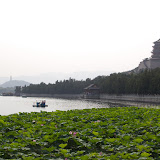
The next afternoon we visited the Summer Palace and the palace Yuan Ming Yuan that was destroyed by the British as a byproduct of the second Opium War. The first summer palace was mainly a Ming dynasty creation and its opulence truly demonstrates the corruption of the leadership…the key symbol of this is a marble boat that had been commissioned by the empress dowager. 

The second palace had absolutely gorgeous park grounds –stretches and stretches of Chinese willows, and ponds full of beautiful flowering lily pads…it was stunning and incredibly peaceful.  And then, throughout the gardens there were bright cloth creations that I can best liken to parade floats maybe?  …You’ll see in the pictures.  After that we reached the ruins of the palace the British had razed…and it is devastating.  It’s not just empty buildings…we’re talking chunks and chunks of once ornately carved marble haphazardly strewn all over. 


For dinner that night we went to Baijia Dazhaimen, a restaurant that fully mimics the imperial court during the Qing Dynasty – from the place settings, to the servants and their attire, to the ingredients in the food.  It is all in a beautiful garden – it was amazing!  We had so much fun!  And at various points performers would come in, again with time period appropriate performances – we had singers, another mask changing ceremony, dancers, and instrumentalists, all at different times. 

July 10, 2011 - Summer Palace, YuanMingYuan, and an Imperial Dinner


Tuesday, July 12, 2011

Night Markets, 798, Temples, and More from Beijing!

The Night Market was not a sight for weak stomachs.  We visited Donghaumen the government monitored open Night Market for an adventurous evening snack.  Stretching for several hundred yards, there were stands boldly baring foods from fried silk worms, frozen fruit sticks, sheep kidneys, starfish, sea horses, snakes on a stick, sea urchins, skewered sharks, bubbling drinks, fried banana dough, even fried scorpions on a stick.  Yes...I said scorpions. 

We worked our way through the market, daring each other to indulge - I tried a few things - bubbling pear juice that looked like it had been plucked from Hogwarts, mystery fruit (that was DELICIOUS), fried banana dough, a veggie dumpling... and I have lived to tell the tale.  My colleagues tried everything from snake to cuttlefish to scorpions and silkworms...and some of them are a little worse for the wear from the experience...

The next day we set out for 798, the contemporary art district in Beijing.  Originally a munitions and industrial area designed by Easter Berliner architects over the past decade, this district has become an absolutely thriving and blossoming hub for aspiring contemporary artists and a showcase for international artists as well. 

Our guides were fantastic and we visited multiple galleries (as you can see in the pictures) and then were given free time to wander the area, and I thoroughly enjoyed ducking in and out of some of the intriguing and compelling galleries. 

We enjoyed another fantastic lunch and then headed into a Buddhist temple that sits North of the Forbidden City and has a staggering 70-80 foot high Buddha at the Northernmost point.  I also enjoyed comparing the Buddhist temple in Beijing with the Buddhist temples I visited in Korea from the way the Buddhas are depicted, the layout of the temples, the practices/interactions of the visitors...there are some intriguing differences and commonalities. 

After that we visited the Confucian temple that had been built during the Yuan dynasty and functioned as the Imperial temple during the Ming and Qing dynasties as well.  Confucian temples are often my favorites - probably because they are centers of learning, scholarship, and respect...

My favorite part was the wooden blocks that lined the bridges leading to the central temple where the emperor woudl sit - each block bore the name of a person hwo had passed the state exam.  There were hundreds, if not thousands...and each one represented a tremendous accomplishment. 

From there we were off to yet another delicious meal - that was a vegetarian buffet and was absolutely fantastic!  I ate my fill of lychee berries ( a new favorite!) and also especially enjoyed some of the various types of mushrooms and eggplant (I don't really like eggplant...but here it is amazing!)

After that we tried to see the author of "When a Billion Chinese People Jump" by Jonathan Watts speak at an English bookstore (that had a very fun atmosphere) called The Bookworm.  We didn't have tickets (it was an impromptu decision to go), but we were able to sit in the cafe and listen to the audiocast - it really was quite interesting. 

On Friday we attended the first day of the International World History Conference and I was very excited to see several of my colleagues from the AP World readings including the textbook author I had spent so many ours working with on the alt exam a few years ago.  The panels have spanned from dry to very intriguing, but I am pleased to say I already have some new ideas for next year....


Day 6 - Night Market


Click on the image to view the album
Blue Skies in Beijing - 798 and Imperial Temples - July 7th


July 8, 2011 the Int'l WHA Conference and Mask Changing Ceremonies